Category Archives: Better Philippines
If The Philippines Were A House
(When the pillars of democracy are broken…)

For years, I stayed away from political writing. The arena felt toxic, exhausting, and at odds with the culture of positivity I’ve been promoting through my self-improvement advocacy. I even avoided crafting satirical poems that confronted human folly through anthropomorphism. But silence eventually stops being a restraint; it becomes complicity. And seeing what my country has been going through, I knew I couldn’t stay silent any longer.
And so, in recent months, I have been writing about the socio-political upheavals in the Philippines, sharing my thoughts on social media and on my website (madligaya.com). The responses flooded in, and as I replied to them, I realized that I had inadvertently answered two painful questions haunting many Filipinos today:
“Is the Philippines really a democracy? ”
and
“Why is the Philippines down on her knees? ”
In my most recent commentary, I asked why religious and civic organizations are inconsistent in their call for accountability. They demand action yet refuse to urge officials to step down. Don’t tell me they don’t know who is most responsible for the biggest daylight robbery of the national coffers—who orchestrated it, who consented to it, and who deliberately turned a blind eye as it happened. And certainly don’t tell me they don’t understand why, when one of those who colluded realized their scheme was about to explode in their faces, he suddenly played both Judas and Pilate—betraying the plot, then washing his hands as if he were never part of it. Only those born yesterday would fail to see that this is exactly what happened.
A friend argued that these organizations actually know the truth. Their dilemma, he said, is that they are choosing between what they perceive as a “weak” leadership and an alleged “power-hungry, iron-handed” leadership waiting in the wings.
I retorted, “By avoiding what they view as the ‘greater evil’ and the ‘lesser evil,’ they end up protecting both.”
The next part of my extended response to his comments led to the answer to the following question:
“Is the Philippines really a democracy? ”
Let me put it bluntly. The leader some people call “weak” is not weak. He is held firmly by the same oligarchs that the previous “iron-handed” president pushed out. Now that these oligarchs have reclaimed power, they will stop at nothing to keep their puppet in place. Power and wealth are their only ideology.
This is the tragedy: the Philippines is not functioning as a democracy. It is ruled by an oligarchy. Many Filipinos fail to see it—or choose not to. Religious and civic groups are not independent moral voices; many are influenced, funded, or even controlled by the same oligarchs.
These oligarchs (and their allies) are firmly embedded (either directly or by proxy) in all three branches of government—the Executive, Legislative, and Judiciary. They took turns in holding the reins of government.
Even our media, the so-called Fourth Estate, is owned by the oligarchs.
So who stands with the ordinary Filipino?
No one.
This provides an answer to the question, “Why is the Philippines down on her knees?”
Answer: The pillars of our democracy have already collapsed.

Ang mga haligi ng ating demokrasya ay giba na.
If the Philippines were a house, it would be crumbling—if not already in shambles.
Since only God knows when, members of the Executive and Legislative branches have been interested only in one thing: the cake—the national budget—and how to divide it among themselves. I cannot help but wonder how much of the money borrowed by past and present administrations truly benefited Filipinos… and how much went to fattening personal bank accounts.
My friend also pointed out that the 1987 Constitution was crafted by academicians, technocrats, and legal minds from wealthy and influential sectors—people who were once powerless under the dictator at that time, but who seized the opportunity after 1986 to control the government and its resources for their own interests.
To this, I replied:
“…and they were displaced when their bets in 2016 and 2022 lost. But when the person you call the ‘weak’ leader won in 2022, they realized they could manipulate him. That put them back in power. They will do everything to keep him in power and stop those who beat them in 2016 from coming back. Why? Because they would lose their grip on both power and the nation’s coffers.”
That is the real picture. Filipinos are sandwiched between the same old political forces that care not about nation-building but about controlling both power and purse.
Kahabag-habag ka, Juan! Kanino ka tatakbo?
Supreme Court? They had the chance to stop the 2025 National Budget fiasco. They were warned. What did they do? NOTHING. In one of my previous articles, I wrote this:
“The judicial branch of the government has constitutional authority to review actions of the legislative and executive branches, including the passage and implementation of the national budget, if these acts violate the Constitution. The Supreme Court had the opportunity to halt the implementation of a budget tainted by secrecy and excess. How? By issuing a temporary restraining order (TRO). They did not (am I right?). Instead, it looked away.”
Judicial silence, in times of moral crisis, is complicity dressed in robes.
The pillars of democracy have already collapsed—and not quietly. The Executive has been seized by oligarchs who pull the strings behind the curtains. The Legislature has turned its power into a marketplace, where national budgets are bartered like goods at an auction. The judiciary, which should have stood as the last upright pillar, now wavers at the very moments when justice demands a spine. Even the media, the so-called Fourth Estate, has been absorbed into the same circle of power, choosing survival over truth. What remains are not pillars, but ruins—and in those ruins, Juan is expected to believe he still lives in a functioning house.
This is not to say that every public servant, judge, legislator, soldier, or religious leader is corrupt. There are still individuals within these institutions who strive to uphold integrity, who resist the pressure to bow to oligarchic interests, and who try—quietly or courageously—to do what is right. But they are outnumbered, outpowered, and often sidelined. In a system where loyalty is rewarded more than honesty, the righteous become the exception, not the rule.
What about the military? What are they doing? Singing “Silent Night” hoping that bonuses are on their way for the Yuletide.
My friend argued, “The military cannot intervene lest they be accused of forming a fascist, Myanmar-style government, which armed leftists and Islamic secessionists would use as an excuse to return to the conflicts of the 60s and 70s.”
To this, I simply replied:
“Their silence is not neutrality. It is consent.”
Wala ka talagang matatakbuhan, Juan.
The church? You must be joking if you think it remains a refuge. Even the devil can wear a habit and hide behind a crucifix.
Kaya, Juan, dumiretso ka na lang sa Panginoon.
At ang iyong ikapu—gamitin mo na lang dagdag sa budget ng pamilya. Ibili mo na lang ng bigas.
And if Juan turns to the institutions outside government, he finds no refuge there either. The military, which should stand as the nation’s shield, has chosen the safety of silence over the burden of service. They watch the house collapse from the barracks, humming neutrality like a lullaby, even when neutrality has become another form of consent. The churches, meanwhile, have grown timid, compromised by political alliances and oligarchic benefactors. Many pulpits now echo carefully measured sermons—loud on morality, silent on injustice. Even the guardians of faith have learned to kneel before power, leaving Juan with no shepherds, only silhouettes wearing cassocks and collars.
The pillars of democracy are broken. Juan’s house has collapsed, and he is helplessly trapped.
At this point, Juan must understand the painful truth: no hero is coming. Not from Malacañang. Not from Congress. Not from the Supreme Court. Not from the barracks. Not from the pulpit. Not from the editors’ desks. The institutions meant to protect him now protect only themselves. And when a nation’s protectors abandon their duty, the people have only two choices — endure the injustice or confront it.
But if Juan remains silent, then he becomes exactly what the oligarchs expect him to be: obedient, afraid, and easy to rule. Democracy survives only when its citizens refuse to kneel. If the Philippines were a house, the pillars may be collapsing—but Juan still decides whether to rebuild or to live forever in the ruins.
The Selective Outrage of Religious and Civic Groups

(When the call for accountability becomes political caution.)
What we are witnessing today is selective outrage. Many religious and civic groups are calling for accountability — loudly, passionately, and repeatedly — yet they refuse to demand the resignation of those who are most accountable for the worst corruption in our nation’s history. Their narratives are carefully stitched, their statements meticulously shaped, but the inconsistency is glaring: they speak of justice, but spare the powerful.
This contradiction raises uncomfortable questions:
Are they playing it safe?
Are they playing politics?
Or has something — influence, pressure, or convenience — convinced them to hold their tongues when saying something against THE MOST ACCOUNTABLE?
It is difficult to ignore the sense that these groups are protecting something—their own interests. If these groups openly call for the resignation of those most guilty, it could jeopardize their influence, privileges, and institutional relationships. And so they walk a delicate line: they must say something to satisfy public pressure, yet avoid saying too much that might offend the powerful. What results is not moral courage but strategic caution—statements crafted to look principled while remaining politically safe.
Silence, especially from those who claim moral authority, is never neutral. It is a position. And in moments when the truth demands courage, silence becomes a signal — not of restraint, but of reluctance.
If accountability is truly a principle worth defending, then it must be applied consistently, not selectively.
It cannot be demanded from the powerless while the powerful are spared.
It cannot be preached from the pulpit and abandoned in the public square… or when expressed in public square, conflicting signals are sent.
And it cannot depend on whether the truth is comfortable, fashionable, or convenient.
Religious and civic leaders wield influence that shapes the nation’s conscience. That influence comes with a responsibility: to speak when it matters, and to stand even when standing is difficult.
A call for accountability that avoids those most responsible is not a call for justice.
It is a call filtered, softened, and restrained — a call afraid of its own purpose.
The public deserves clarity.
The nation deserves sincerity.
And leadership — especially moral leadership — deserves consistency.
Pro-politico or Pro-Filipino?

A Personal Stand
While I was enjoying the Chuseok celebrations here in South Korea, I received two calls on two separate days asking if I could join the “meet-and-greet a politico” at the end of this month at the Philippine Embassy here. I politely declined.
Before extending the invitation, I was first asked about my political sentiments. I candidly said I don’t like to meet any politicos nowadays – not Marcos, nor Duterte, nor any of those pretending to be public servants “pero mandarambong pala.” They are all responsible for the sufferings of the Filipino people. Only those who were born yesterday, blind, and naïve would not acknowledge this. They are ALL guilty and should be held accountable. I’m giving the benefit of the doubt to the neophytes in Congress (who did not serve in the 19th Congress) and new members of the Cabinet.
I told those people who invited me that I have decided not to support any political personality. Amidst all the political turmoil and government dysfunction, I would like to take not a “pro-politico, ” but a “pro-Filipino” stance. Attending that gathering is tantamount to turning a blind eye to their wrongdoings.
Actually, I coined an expression that is very appropriate for those guilty of plunder and malversation of public funds… “BUWAYANG INA N’YO.” I am afraid I might blurt this out when I see a politico nowadays. Just imagine if I were to hurl this invective in the face of one in that gathering.
Half-jokingly, I said I hope my passport will not be revoked because of my political beliefs.
The Semantics of Corruption
I offer no apologies for using the word ‘politico’ (instead of ‘politician’) in the title. The word is considered derogatory, yet it is the most appropriate way to describe most elected (and appointed) members of the legislative and executive branches of our government.
An online dictionary says, “You can describe a politician as a politico, especially if you do not like them or approve of what they do.” Let me ask you, “Do you approve of what those people in the government do?” Another online dictionary defines ‘politico’ this way: “someone who will do anything to win an election.” The worst example of “will do anything” is “vote buying.” Are the politicos you are supporting not guilty of this? Chat GPT puts its best: “Politico suggests a type of politician – often one driven by ambition, opportunism, or self-interest.”
How I hate “Grammarly” for insisting that I use “politician” instead of “politico.” The algorithm must not know that “politician” is too kind a word for our breed of thieves in barongs.
It fails to grasp that “politico” carries the stench of corruption that “politician” politely hides.
And please, let’s stop addressing them as honorable. They don’t deserve it. They are very much the opposite of that word. “Puwede bang ituring na kagalang-galang ang mga dorobo?”
So, I ask you: Are you pro-politico or pro-Filipino?
The Nation Plundered
The politicos are slowly destroying our nation. They will continue to do so unless we take action. Through the years, they have systematically plundered the nation’s coffers. What were once mere allegations are now supported by emerging evidence, showing that members of both the legislative and executive branches have been dividing the national budget among themselves like a cake. Each takes a slice, along with the icing, leaving only crumbs for the Filipino people.
The greater tragedy is that the Filipino electorate continues to vote for the same politicos. Voters in the Philippines often elect members of the same political clans, as if nobody else is capable of leading the country but those from their own clan.
And what have we gained from voting for them? Did our nation prosper under their leadership? Did voting for them put food on your tables or roofs over your heads?
The Filipino people themselves put the reins of government in the hands of a small group of individuals —the political clans in the Philippines. They are the politicos controlling our nation, its organizations, and institutions.
You may disagree with it, but the Philippines is actually not a democracy, but an oligarchy. The government is run, either directly or indirectly, by the country’s oligarchs, who are also politicos.
The Silence of Institutions
And do you think these oligarch-politicos will ever be convicted of plunder and malversation of public funds? Well, hope springs eternal. But the way I see it, “mga dilis lang at bangus ang huhulihin; iyong mga pating at balyena ay pakakawalan.”
Where was the Supreme Court amidst all the brouhahas? Gentlemen and ladies in robes, “Hindi po kayo safe.” I am not a lawyer (and please correct me if I am wrong), but the judicial branch of the government has constitutional authority to review actions of the legislative and executive branches, including the passage and implementation of the national budget, if these acts violate the Constitution.
The Supreme Court had a chance to stop the bleeding — to halt the implementation of a budget marred by secrecy and excess. How? By issuing a temporary restraining order (TRO). They did not (am I right?). Instead, it looked away.
Judicial silence, in times of moral crisis, is complicity dressed in robes.
Was that judicial restraint, political caution, or internal division? Whatever the case, the result was the same: the budget proceeded while constitutional questions lingered unanswered.
The Fourth Estate, Bought and Sold
“Paano na? Kanino tayo tatakbo ngayon?” The nation is plundered by the members of the executive and legislative branches of government, and the judiciary is doing nothing. Can we run to the Fourth Estate, the fourth pillar of our democracy – the press or mass media? Unfortunately, NO! Search for the meaning of “envelope journalism” and you’ll know why I said so.
The media moguls, who are often oligarchs themselves, are businessmen. The media is intended to safeguard the truth and hold power accountable. But when it sells its soul to the highest bidder, it ceases to be the people’s voice and becomes the regime’s echo.
That’s how grave our situation has become in the Philippines. The legislative and executive branches plunder the nation’s wealth with impunity, while the judiciary looks away, pretending blindness in the face of daylight robbery. The fourth estate, once the voice of truth, now speaks in the language of those who can afford to pay for silence. In a nation where justice sleeps and journalism is bought, who then speaks for the Filipino?
The People’s Guilt
Can the Filipinos rely on themselves?
The answer is very disheartening. Filipinos throw mud at the very politicos they helped elect. They fail to see that they, too, have benefited from the money stolen from the nation’s coffers through the cash handed to them during election season. By accepting that money, they become accomplices. Their hands are as dirty as the politicos they condemn.
Were you born yesterday? Are you blind? Are you naive?
Those born yesterday are the ones who do not understand the concept of “command responsibility.” Those who are blind cannot see that the politicos have been siphoning money from the national coffers to their personal bank accounts. Those who are naive pretend not to know that even the politicos they support are guilty of plunder and malversation of public funds.
It’s time to remove the blindfold—and see our nation for what it has become, and how much the politicos have destroyed it.
As a nation, we have a decision to make. “Patuloy ba tayong magpapagamit at magpapauto sa mga tulisang pulitiko?
The Call to Conscience
We, the Filipino people, are the salvation of our nation. If these “buwayang inang” politicos will not heed the call for them all to resign, at the very least, let’s not vote for them in the next election. Let’s remove the oligarchs from the political landscape. Let them enrich themselves through their legitimate businesses, not through our national budget.
Perhaps it is time we stopped pledging allegiance to politicos and started standing for the people, for the Filipinos, for the Philippines. For once in your life, abandon the political personalities you are supporting until you have proven beyond a reasonable doubt that they are not guilty of plunder and malversation of public funds.
To be pro-Filipino is to reject the culture of impunity that thrives in envelopes, offices, and chambers of power. It is believed that love for country begins not in applause for politicos, but in outrage against their deceit.
For the soul of our nation, silence is no longer an option.
What Now, Philippines?
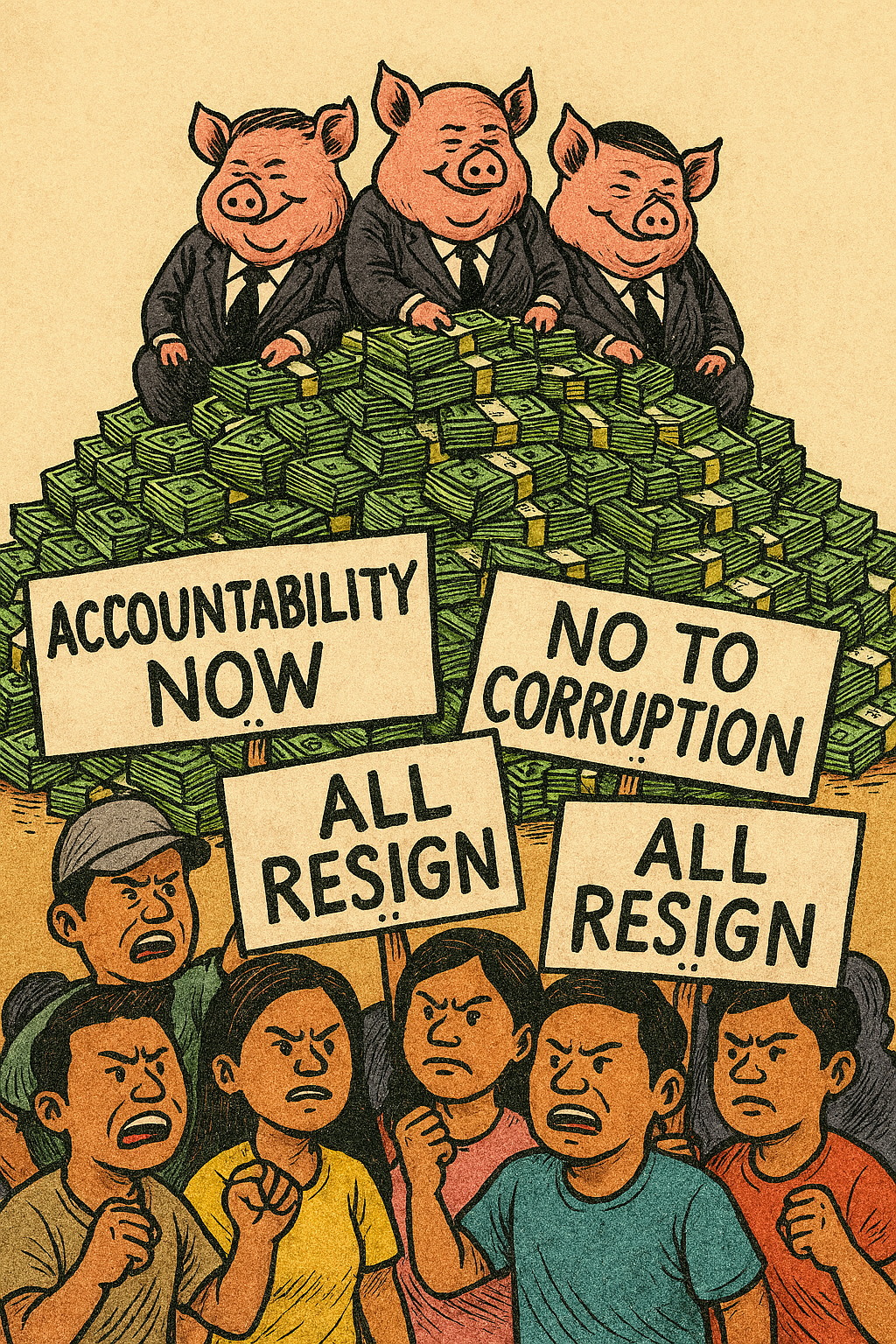
Yesterday, I spoke with a friend here in South Korea, and we discussed the situation in our country. She was as gravely disappointed and angry as I was (just like the millions of our countrymen back home) by the blatant plunder of our national coffers. The story of the flood control program, a tragi-comedy, has taken many twists and turns, and the plot continues to thicken.
We agreed that it was right for the South Korean government to halt its P28-billion loan to the Philippines amid corruption concerns. I added that no financial institution anywhere in the world should lend to the Philippine government until those who stole from the nation’s coffers are brought to justice—and a transparent, foolproof system of government spending is implemented. Mga kapalmuks kayo, mangungutang tapos paghahati-hatian lang ninyo.
We disagreed as to who should be blamed for the flood control project scam. According to her, by virtue of command responsibility, the President is most guilty. She considers it improbable that the Chief Executive did not know about the wrongdoings of his alter egos from the very beginning. Why did it take him three years to expose the corruption happening right under his nose? His duty is supposedly to prevent such corruption practices from happening under his watch. Did he only discover the substandard and ghost flood control projects this year? And why did he exclude himself from blame when he said, “Mahiya naman kayo” during his SONA a couple of months ago? That should have been “Mahiya naman tayo.”
And if these demonic acts of plunder also occurred during the times of Presidents Duterte, Aquino (Noynoy), Arroyo, Estrada, Ramos, and Aquino (Cory), then all of them should be held accountable as well. “Mahiya naman kayong lahat.”
I told her that blaming the President is correct. Still, half of the blame should be borne by the Filipino electorate who voted for those greedy politicians, fattening themselves like pigs in the supposedly august halls of Congress, now nothing more than a stinking sty of corruption.
We deserve the leaders we elect. There are many Filipinos who are very angry with what the politicians are doing, not realizing that they should be partly to blame for what is happening because they voted for those corrupt leaders. The truth is “Nakakahiya tayong lahat.”
Suppose we are genuinely seeking accountability and transparency. Why is nobody suggesting that the yearly National Budget from the time of Cory Aquino (1986) to Marcos (2025) be scrutinized and checked to see how the budget of DPWH (and other government agencies) was allocated each year? It is not only the records of the budget of the DPWH that should be scrutinized but all the departments of the Executive branch. The records will definitely show who, among the Senators and Congressmen (past and present), made “insertions.” A thorough investigation and accounting should be made to determine who among the members of the Executive and Legislative branches of government, past and present, colluded to plunder the nation’s coffers. The truth is written in all those documents.
We also agreed that the Philippine government, as presently constituted, has lost its credibility to govern. Which branch of government is trustworthy now? The Executive or the Legislative branch?
That is for you (the readers) to answer. But as far as I and the friend I talked to yesterday are concerned, it’s scary to entrust the future of our nation to anybody from Malacañang, the House of Representatives, and the Senate.
What about the Judiciary? Can the Filipino people trust our Justices? Did they perform their solemn duty to intervene and restore constitutional order when they were flooded with petitions challenging the constitutionality of the 2025 General Appropriations Act (GAA)? What happened to their hearings? Did they do something to prevent the kleptomaniacs from dipping their hands into jars of people’s money? None that I could recall (and please correct me if I am wrong).
If none of the three branches of government could be unequivocally trustworthy, what about the fourth estate, the media? Do they genuinely care about the Filipino people? My answer is simple: they are too busy building their business empires.
But if neither government nor media can be trusted, then the responsibility ultimately falls on us, the Filipino people.
The last question we addressed in our conversation was, ‘What should be done?’
What should the Filipinos do now?
I was surprised that she was thinking the same thing I was… REVOLUTION.
We agreed that all the investigations being done by both the lower and upper chambers of Congress on the flood control project anomalies will amount to nothing. Even the planned independent commission cannot be expected to be genuinely independent. The loyalty of the members belongs to the authorities that appointed them.
Politicians have their way of sweeping under the rug the messes of their colleagues. They have mastered the art of compromise to such an extent that, in the end, only the lowly contractors will serve prison time.
Meanwhile, the equally guilty, high-ranking individuals in the government—who belong to wealthy and powerful families—will only receive a slap on the wrist.
Honestly, I have entirely lost my faith in our government. I don’t know who among them can be trusted. Even the international community has doubts about the moral ascendancy of our leaders to hold the reins of government. The South Korean government is the first to cast doubt on the trustworthiness of our government. And soon, other countries may. For the first time in my life, I find myself hesitating to say I’m from the Philippines.
Somehow, the only credible government institution now is the Military. They are our “second-to-last” hope. They need to take control of the government, either peacefully or by force. Everybody in the government must resign. The Military must investigate the widespread corruption and send to jail all those who are found guilty. They must do a comprehensive audit and accounting of all government expenditures. They must start with the yearly National Budget from the time the Marcos dictatorship ended up to this year. They should not leave any stone unturned.
The crooks must be prevented from running for any public office. When finally justice is served, the military shall order new elections to elect a new government.
If the military will not take over, we could be heading in the direction that the Indonesians and the Nepalese went. We must not allow the present government officials to continue running the affairs of government.
As I said before, the Military is our “second-to-last” hope. But our final hope—the true hope—rests with us, the Filipino people.
It’s time to breach party lines and set aside ideological differences. Let’s stop supporting any politician and stand together in love for our country. The slogan should be clear: “Save Our Nation,” not “Save a Politician.” We have been exploited and betrayed by greedy politicians for too long—it’s time to take back our country.
And when the time comes to exercise our freedom of suffrage again, we must vote for the most qualified leaders. It’s time to weed out the politicians and choose leaders who are true statesmen, not career (greedy) politicians.
It’s time to reclaim our nation. The time is now. When we march to the streets, bring no party banners, only our nation’s flag.
The Floodgates of Command Responsibility

The Secretary of Public Works and Highways (DPWH) appears to be taking all the blame as the scandal surrounding the flood control projects unfolds. The question is this: Whose conscience will get inundated with guilt if we open the floodgates of command responsibility?
Suppose we adhere to every aspect of the command responsibility framework. Shouldn’t someone be uttering the well-known phrase, popularized by U.S. President Harry Truman, “The buck stops here”?
Who should be saying, “The final responsibility rests with me”?
Who is conscientious enough to say, “I take full responsibility”?
Nobody is doing so. Instead of doing a Harry Truman, the mayors, governors, congressmen, and senators are all doing a “Pontius Pilate.” I will not be surprised if, in the days to come, these Honorable Gentlemen and Ladies will also do a “Judas Iscariot.”
I don’t know if President Bongbong Marcos was correct in using the pronoun “kayo” when he said “Mahiya naman kayo” in his latest State of the Nation address. I think it should have been “Mahiya naman tayo.” He would have gained more admiration had he used “tayo” instead of “kayo.” While the DPWH is directly responsible for implementing flood control projects, the President, as the head of the executive branch, bears ultimate accountability for ensuring proper oversight. At least, His Excellency is now correcting the acts of omission and commission (and yes, the “commission,” if you get what I mean). He should be given credit for that, although “prevention” would have been preferable to “correction.”
Did you see how some local executives, congressmen, and senators crucified the DPWH officials and contractors? Did they not know about the substandard and ghost flood control projects in their respective localities? Did they not really know about the corrupt practices happening right under their noses? Come on, we were not born yesterday.
Nobody will believe you, even if you deny to death that you know nothing about the substandard and ghost flood control projects. It is improbable that nobody informed you that these mega projects are being undertaken in your jurisdiction. As a VIP (being an elected official), nobody in their right mind would construct anything in your backyard without notifying you. Furthermore, it is impossible that nobody whispered to you about “for the boys.” Whether you accepted or rejected it, only you and God know.
Don’t be a “Pontius Pilate.” You may not be guilty of accepting anything passed under the table, but why are you not brave enough to say that you actually turned a blind eye? Don’t act now as if you are the champions of your constituents and during TV interviews hurl all those invectives against those who are now tagged as suspects in the “flood control project scams.” Your act of washing your hands on national television didn’t go unnoticed. It’s not funny at all. If only we had an intelligent electorate, I doubt you would get reelected because of it.
We need to answer the following two questions:
“Is it proper for the House of Representatives to conduct an inquiry into the flood control project scam?”
“Is it proper for the 12 remaining senators from the 19th Congress to join the ongoing investigation of the Senate’s Blue Ribbon committee on the same issue?”
Just asking!
There is another web whose strands we need to trace aside from command responsibility. It’s the web of corruption. The webs of command responsibility and corruption are connected.
Who is responsible for the Congressional appropriations for the 2025 National Budget’s subpar and ghost flood control projects?
Who is brave enough to say, “I bear ultimate responsibility”?
Who, after a deep reflection, would say, “The final decision and its consequences are mine to bear”?
And please don’t mind me asking a last question:
Whose bank accounts fattened through the scam involving the flood control project?
Puwede po bang makabalato?
The Business Venture Called Politics
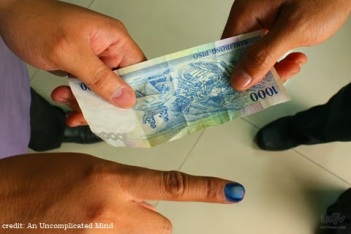
How many of the incumbent local and national officials in the Philippines (and also in your own country) can come forward and with heads held high say that they did not buy their way to victory?
The painful truth is that elections have turned out to be a business venture. Politicians are like businessmen who if they hope to win must be willing to make an investment. And the investor in the politicians would expect a profit, not just a return on investment.
How much should a politician invest? Do the math.
According to the Commission on Elections, the number of registered voters for 2022 polls hit 63 million.
Last year (2020), the House of Representatives approved House Bill No. 6095 amending provisions of RA No. 7166. The bill provides that those running for President and Vice President can spend up to P50 per voter for their campaign. That used to be P10 per voter. From P3, senators, district representatives, governor, vice governor, board members, mayor, vice-mayor, and councilors are now allowed to spend up to P30 per voter. But those who were not born yesterday know that candidates for national and local elections spend way much beyond what the laws allow.
Beyond what the statutes allow, a candidate has to dig deeper into his pocket if he hopes to win. Vote-buying is no longer a secret making this writer say that election now is nothing but a business venture. It is no longer the best and most qualified candidates getting elected but the ones who have enormous financial resources.
A candidate willing to pay at least P500 for every voter is likely to win. The percentage for winning gets higher if the one seeking an elective position has the capacity of making that amount higher… like P1000 to P2000 for each vote.
Now, do the Math if you wish to know how much a candidate needs to prepare for his election bid. Include the amount needed for campaign advertisement, salaries of campaign leaders per geographical unit (province, town, city, barangay, districts, or zones) depending on which position is being sought, and other miscellaneous expenses. Don’t forget to add the amount a candidate is willing to pay for each voter (multiplied by the number of voters.)
For the millions of pesos those candidates extricate from their coffers what do they wish to get in return?
It’s not difficult to determine what drives people to run for election (and seek re-election). It’s as simple as A, B, or C.
A – a political position is a business venture for which they expect to get returns for their investments and a whole lot of profit (How? Use your imagination!!!).
B – an opportunity to wield power allowing the one who holds it to protect personal and family interests and to advance other personal motives and agendas.
C – love for public service.
The citizens who care are hoping it’s the C. For those who sell their votes, A and B. Why? Come on, don’t tell me you don’t know.
Let me end the way I started – with the following question.
How many of the country’s incumbent local and national officials can come forward and with a head held high say that they did not buy their way to victory?
Allow me to ask one more question.
How many local and national officials whose assets did not exponentially increase at the end of their terms?
And one more…
How many of them ran (and obviously won) and will seek reelection – for the love of public service?
What We Filipinos Ought To Realize (4)
(Last of 4 parts)

In the first three parts of this series, I identified our serious faults as Filipinos – we sell our votes, we use questionable standards when choosing leaders, we treat elections as if they are popularity contests allowing immensely popular but inexperienced and incompetent celebrities to win, and we either keep restoring from the “recycle bin” the same traditional politicians or replace them with any of their family members.
Our inability to choose the right leaders is clearly one of the factors preventing us from reaching our full socio-political and economic potential as a nation.
We know that the government plays the most essential role in leading all efforts to make this country progressive. We need the best leaders if we really want to become a “developed nation.” It is our responsibility as citizens to select the best ones to hold the reins of government. Unfortunately, we keep failing to do so.
The funny thing is that after we put them into power – the politicians who won because they have the money to buy votes, celebrities-turned-politicians who are inexperienced and incompetent, and “recycled politicians” and the members of their political dynasties – we expect them to perform well. After every election, we expect a better-performing government.
And why would we expect a different government – a more effective one – when we know that we keep electing the same politicians or use the same old rotten standards when choosing new leaders?
Let us revisit Albert Einstein’s definition of insanity – “Doing the same thing over and over again and expecting a different result.”
But assuming that one day we restore our sanity and finally we refuse to sell our votes – finally we learn to elect into office the most deserving and most qualified among candidates – would the wheels of national development start rolling?
Not quite yet!
There’s one more problem, a problem more serious than our failure to vote wisely and conscientiously. The more serious problem of Filipinos, as mentioned in the first part of this series, is the mindset that that the leaders we elect are solely responsible in solving all of our society’s ills and nation’s problems.
We view our relationship with the state at the vantage point of “self-entitlement.” We think that it is the duty of our leaders to give us “this and that.” We say that the government should do “this and that” for us. See, we expect too much from leaders whom we don’t even choose using the best and most appropriate standards.
Is it the duty of the government to provide each citizen with food, clothes, and shelter?
Of course not!
What the government does, generally speaking, is to formulate, implement, and enforce the laws of the land, to build infrastructure, to ensure peace and order, and to create economic and other opportunities that would help its citizens enjoy the conveniences of life and have the best chance to get good education and find or create means of livelihood.
It is also not the duty of the government to provide everybody a job?
One of the functions of the government is to create an environment that would promote economic growth. They have to make sure that businessmen would be encouraged to invest and initiate businesses activities thus creating job opportunities. But jobs are not given in a silver platter. We have to search for job openings and apply and make sure that we have the required qualifications for the jobs we want. Getting ourselves ready for employment is a personal responsibility. The government will not deliver to our doorsteps the jobs that we want.
The government itself is also an employer but it cannot possibly provide each citizen with a job. It is also impossible for the private sector to employ everybody. That’s just the reality. Harsh it may be. Those who won’t get employed, or do not want to work for others because they have better plans for themselves, could perhaps succeed as entrepreneurs.
Not everybody would get a college degree. Not everybody is trained and destined to be in a workplace – either in the corporate world or in the academe. Some of us will be factory workers, sales clerks, farmers, fishermen, plumbers, drivers, gardeners, or what-have-you. It doesn’t matter whatever jobs we have for as long as they are decent and they allow us to earn a living honestly.
Don’t reason out that you came from a poor family and your parents could not send you to school to get a good education and have a better chance for a better life.
This is just how many of us Filipinos are. When we don’t succeed in life, when things don’t turn the way we expect them to, when we are not doing well in the different areas of our personal lives, we are always ready to check our “blame list” to find somebody or something to put the blame on. And our favorite whipping boy – the government. When we are done accusing our leaders for not doing their job well causing us to become losers, we next vent our ire on our parents saying that they did not work hard enough to ensure that we live a good life when we become adults.
We need to throw away that “blame list” for whether we like it or not we are personally responsible and accountable for our success and failure. There comes a time in our lives when we should become be self-sufficient, a time when we, not the government nor our parents, decide for ourselves and take full control of our destiny.
We Filipinos need to realize that unless we recognize our faults and change there’s no way our country becomes progressive and “developed.” We will never gain the respect of the community of nations if we remain the way that we are now.
Something was said by John F. Kennedy that we should reflect upon – “Ask not what your country can do for you – ask what you can do for your country.”
We Filipinos ought to realize that there are two requirements for a country to become progressive and developed – good government and cooperative citizenry. Remove one and a country is doomed. The citizens and their leaders need to work harmoniously towards achieving national goals. There’s no other way. Both of them need to work hard. They have to work hand in hand. The one thing we should bear in mind is we have control over who would lead us, of who will be holding the reins of government. So, if we fail to choose the right people to man the executive and legislative branches of our government, then don’t expect our country to do better… to be better.