Category Archives: ESL Teaching
Getting Through The First Day Of Class
(A Personal Essay)
 Each meeting with my students is important but it’s the first day that I consider very special – the most strategically important. It’s the day that I would attempt to accomplish one of the hardest things to do in education – to shatter the students’ image of the classroom as a prison cell, with them as prisoners and the teachers as nasty prison guards. It’s the day when I begin to lay the foundations of what every teacher should endeavor to forge between them and their students – a good rapport.
The entire semester is a long haul and I know that winning their hearts would make our journey together as enjoyable and productive as it could be. If I succeed in making them trust me during the first day, half-of-the battle is already won. Earning the trust of my Korean students is very important to me as an expat teacher teaching English. What makes that task of earning their trust not only necessary but also (doubly) challenging is the fact that I yes I am an ESL teacher with the proper qualifications and training but I am not from any of their preferred native English speaking countries.
There’s nothing very special about the way I conduct my first meeting with my new students here in South Korea. It’s just a bit unconventional.
My introduction would always include telling my students the nickname which I adopted with the intention of eliciting laughter whenever I deliver a talk – Tonitonipoponibananananapoponinomimayfofoni. (Inspired by Laura Branigan’s song entitled “Name Game.”) Amazingly, when I tell my students that and jokingly threaten them to memorize it if not they would fail in my subject, they would try very hard to repeat it after me and laugh at themselves if they wouldn’t be able to say it.
Then I would add, “Whoever could say my nickname correctly will get an A+.” I don’t mean it of course. Luckily, up until this time, no one among those who tried succeeded. It was me who would always succeed – in getting their attention.
From there, I would give them the necessary information about me as their teacher. The most significant of those information (as far as I am concerned) is the number of years I have been teaching. It currently stands at (a few months more than) 30 years. The point I wish to drive home for highlighting to my students how long I have been teaching is – I wouldn’t stay this long in the academe if I don’t love my job.
The next part of my first-day-of-class script would touch the boundaries of philosophy.
I would be delivering something like an“eve-of-battle” speech. The way they do it in movies.
I would ask my first question: “Why am I teacher?”
Puzzled, the students would grope for an answer.
I would give follow-up questions after that – Would you call a woman a mother without a son or a daughter? Are your mothers and fathers mothers and fathers without you as their children?
Amid their “aahs” and nods I would then say, “I am a teacher because of the students. My reason for being a teacher is each of you. Without you, I am just a person – not a teacher.”
That’s my way of telling my students that the most important stakeholder in a school are them. Schools exist because of them. School administrators and teachers have work because of them.
That’s my way of telling them that I exist (as a teacher) to serve their interests.
I would end that part with the following statement: “Thank you for having me as your teacher.”
After that I would show them a video clip from the movie “Collateral Beauty” – that part where Howard Inlet, the character played by Will Smith, delivered a speech in a gathering of his employees at the beginning of the movie.
- “What is your why? Why did you even get out of the bed this morning? Why did you eat what you ate? Why did you wear what you wore? Why did you come here?”
I would pause the video clip after each question and would ask them to give an answer.
Then I would ask them follow-up questions. (These were the only questions I asked when I was not yet using that movie clip.)

Why are you here in school?
Why do you want to finish your studies?
The last question I would ask – Why did you enroll in this class?
I never failed to ask the said questions because I want my students to understand that for them to succeed not only in their studies but in all their present and future endeavors, they need to set goals. They ought to know their whys. They must know the reasons why they do what they do, say what they say, and think what they think.
I would tell them also that the worst “why” to have for studying is to get A+ – that grades are not the be-all and end-all of schooling.
All of the foregoing would be finished in twenty to thirty minutes.
I would then ask the student to introduce themselves.
After all of the foregoing , I would proceed to the presentation of the course syllabus – explain the course objectives, give the topics to be discussed weekly, and tell them what activities will be done in the class and how are they going to be graded.
In explaining discipline in the class, I would simply ask this question – “Are you small children?” They would of course say “NO.” Then I would tell them this – “I therefore expect you not to speak and behave like small children.”
Then we proceed to the finale – presentation of course requirements.
It’s not surprising to see the students frown when they see the course requirements on the last page of the syllabus. That’s the time that I would deliver the last part of my “eve-of-battle” speech.
I would ask – “Is learning fun?”
As expected, majority would say “no.”
My next question would be – “Is work fun?”
Of course the students would say “no” again. And every time I would ask that, one or two would say “There were many times I heard my father complained about his job.”
Then I would go on and tell them the following:
“Nothing is to be given to you in a silver platter. You need to work hard to achieve your dreams. Studying and working would require effort – you have to exert mentally, emotionally and physically. But something could make studying and working fun – your attitude. Your attitude towards studying will be dictated by your whys. Your whys put together is your philosophy.”
I would spend another minute or two to explain something about “personal philosophy.” At the end I would tell them that each teacher has a personal teaching philosophy and mine is as follows:
“The classroom is my playground. The students are my playmates. The subject is our toy.”
How surprised they would be whenever I say that when I come to class I don’t work, I play. Work is hard. Play is fun.
As we end the first meeting I would tell them, “Come back next week and let’s play.”
Teaching in South Korea
(My Journey as a Teacher – 4)
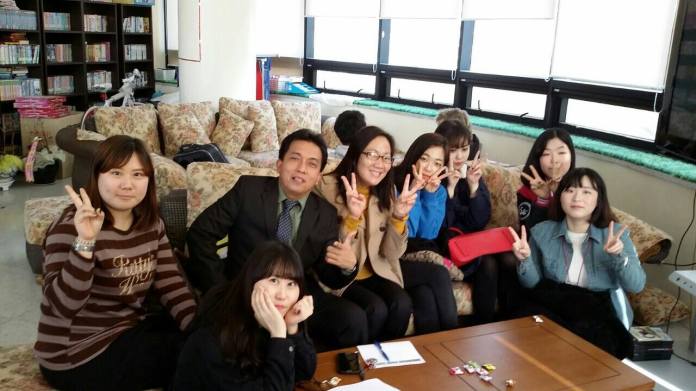
I decided to try ESL teaching here in South Korea not because there were no teaching jobs available in the Philippines for me then. As a matter of fact, I had to cut short my employment back home in 2013 to come here. That time I was employed as Principal of a basic education institution. To earn extra, I also worked as a part-time instructor in a college and academic consultant in another school .
I had no problem finding jobs in the Philippines.
So, what made me decide to teach here?
Firstly, I suffered from a severe “job burnout”. I got so tired being a school administrator and a teacher at the same time. There was no sense of fulfillment. I desired to go back to full-time teaching and try to discover what I was missing.
I started doing supervisory works in 1994 in a technical-vocational institution. I resigned in 2002 then moved to another school, a Catholic tertiary institution, where I was offered a supervisory position – head of the Education program. From there I became a college dean in another school then principal in a basic education institution. From 1994 to early 2013 I was a school administrator and a teacher at the same time.
I really got tired supervising people and doing administrative works. I felt sick about it. I wanted to go back to just being a teacher. That’s the reason I applied for a teaching job in South Korea. Luckily, I was hired.
It was that “job burnout” that got me seeking for a job opportunity overseas. Not that I wanted a greener pasture. I would be branded a hypocrite if I say I don’t need a higher pay. But I was really satisfied with the salary I was receiving at that time. It was good enough that it enabled me to buy a small parcel of land and had a house built.
Of course I am happier and more satisfied with my monthly pay in this country. Who wouldn’t be. It’s roughly 75% higher than what my Pakistani employers paid me in the Philippines and with me having to work 60% less in terms of hours. That basic (K to 12) education school where I was Principal is owned by Pakistanis operating a vast network of schools (The City School) in Pakistan and some parts of Asia.
At that time I felt that I was at the crossroads of my career. I have to admit that there was some kind of dissatisfaction within me. Burnout torched my soul and I was really unhappy.
Then came the opportunity to teach here.
When I got settled, I figured out what was missing. Because I was so busy with my administrative functions and was teaching at the same time, I was not able to attend to my other passion…WRITING.
In the Philippines, being a school administrator and teacher at the same time require that you stay in the workplace, officially, for 8 hours a day. But most of the time, I would stay way beyond that, even if I wasn’t required to. It was just something that felt I ought to do. Sometimes I would even go to my office on Saturdays. With that hectic schedule, I could hardly find time to write poems, essays and stories… much less do research.
That’s what makes teaching in South Korea different for me. It afforded me a lot of spare time which I could use to write. I was even able to write papers for presentations in international conferences and for publication in international journals. Something that, unfortunately, I couldn’t do in the Philippines. Back then I would be lucky if in a month I could write even just a poem.
ESL teaching is part of the career-path I paved for myself. I really trained and prepared for this. As early as 2009, I was already thinking of coming to this country to become an English teacher. I applied also in schools in the Middle East but it was my hope that I would be given the opportunity to do ESL teaching here.
I did not become an English teacher overnight. I am a licensed English teacher in the Philippines. I passed the Licensure Examination for Teachers 2003. Then in 2010, notwithstanding my busy schedule, I enrolled for a certification class in TESOL (Teaching English to Speakers of Other Languages).
My second (and last) reason for deciding to try teaching here (South Korea) has nothing to do with my career. At that time I was journeying to midlife. There were some personal demons that I OUGHT to slay. It’s too personal to share. Suffice it to say that I needed space. I needed that entire space between the Philippines and South Korea to really get my bearings back.
Then my efforts paid off and my prayers answered. I was hired by a South Korean university in 2013.
God is really good. I got what I wanted… just teach and no more supervisory works. That gave a lot of time to write. I was also able to squeeze myself out of a personal crisis. I wouldn’t have not done so had I opted to just stay in that principal’s office.
My journey as a teacher continues. I don’t know for how long it would last.
As I said in another essay, “Nobody knows if where I am teaching now is the final leg of my journey…my final destination. I’d love to if given the chance.”