Blog Archives
“Till We MEAT Again”
Some of the meat dishes I tried here in South Korea are somewhat similar to the meat dishes in the Philippines.
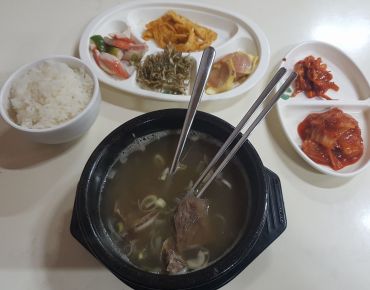
갈비탕 – Galbitang/Kalbitang
One Korean beef dish that reminds me so much of our own “nilagang baka” (Filipino beef stew with clear broth) is 갈비탕 (galbitang/kalbitang). (I had to tell my Filipino friends in the Filipino version of this article that G and K in Hanguel are used interchangeably thus kimchi when written in Romanized form could also be gimchi.)
Kalbi, in English, is short ribs. When Filipinos cook beef stew, it’s also the ribs of the cow they choose. But while in the Philippines we add Chinese chard, potato, cabbage and saba (a banana variety used primarily for cooking), with kalbitang, mixed are radish, dangmyeon (starch noodles) and onions. In a restaurant, I was once served kalbitang with egg. I was also told that it can also be cooked with kimchi. That I have not tried yet.
Tang means soup. Synonymous to tang is another Korean word – guk. Thus, if at the end of the name of a certain Korean dish there’s either tang or guk, expect that the meat is cooked with soup. 삼계탕 (samgyetang) for example is soupy chicken dish. It is comparable to the Filipinos’ tinolang manok (chicken stew) which is cooked with either green papaya or chayote and ginger. What primarily goes with samgyetang when prepared are red dates, ginseng, onion, and garlic.
Another Korean meat dish that has striking similarities with another famous Filipino food is 설렁탕 (seolleongtang). For kalbitang, the part of the cow used are the ribs but for this dish called ox-bone soup in English it’s the leg bones. Usually prepared with spring onions only but one time I have tried one with radish and thin wheat flour noodles. It’s similar to Philippines’ bulalo (beef marrow stew.)
What about pork dishes?
I’m familiar with two… one of which is actually my favorite. These two Korean pork dishes is not like any of the pork dishes I got accustomed to in the Philippines. They are uniquely Korean.

감자탕 – Gamjatang
The first one is 감자탕 (gamjatang). It’s pork neck bones that are used to make this Korean meat dish and usually cooked with potatoes (primarily) and other vegetables. There seems to be a disagreement among Korean food experts as to what gamja in gamjatang refers to – is it the potato or meat around the pork spines bones? So, it’s not settled yet as to how should it be called in English – spicy pork bone stew or potato stew. For the meantime, forget about the name. Just enjoy the taste.
The second and last pork dish… and the last among the Korean meat dishes I wish to feature in this article but not the least because it’s actually my favorite meat dish here… is 뼈해장국 (ppyeo haejangguk).

뼈해장국 – Ppyeo Haejangguk
Others would simply call it haejangguk, which means, according to existing literature, hang-over soup. I’m more used to calling it ppyeo haejangguk for that’s how it’s written in the menus of restaurant where I ate them. One thing that I have noticed is that it is somewhat similar to gamjatang minus the potatoes. Both are spicy but when you order you can request that it be made less spicy or not spicy at all. I was told that there is a variety of haejangguk where instead of pork spine it’s ox-bone that is used.
Of all the meat dishes I tried here in South Korea, ppyeo haejangguk is my favorite. It doesn’t mean though that I need to eat it often because of hang-over. I just love the taste and the spiciness of this meat dish. The price ranges from 5,000 KRW to 7,000 KRW.
Two other meat dishes I came to like here are the following:
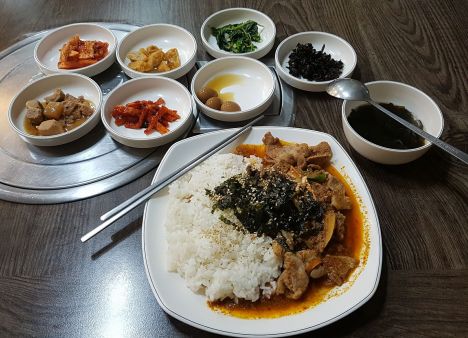
제육덮밥- jeyuk deopbap
There are more meat dishes here in South Korea but the five I presented here are the top 5 in my list. It is very possible that after my 5 years being here I may how not tried some them yet.

족발 (jok-bal)
I wrote an article in Filipino about Korean meat dishes in order for my friends in the Philippines to know the different ways Koreans cook meat. This is the English version of the said article. The beef, pork and chicken dishes I mentioned in that write-up were limited to the ones that I already tried. I focused mainly on what I literally saw on the bowls and plates when I ate them… like what kind of meat were they, which parts of the cow, chicken or pig were used, and what vegetables and other ingredients were mixed. I added some personal observations.
— o —
“Pork-bellied”
 This is about my first 삼겹살 (samgyeobsal) experience… why the pork belly should be faulted for my becoming “pork-bellied.”
As I said in the article “Love at First Bite,” I fell in love with kimchi. But I have to admit that with all the luscious Korean… DISHES, I wasn’t faithful to kimchi. I would later fall in love with other Korean foods. I also completely abandoned my plan to loose weight. It’s a “mission impossible.”
Before my first week in South Korea ended, we were given a treat by sir Randy. He brought me and two other foreign professors (Deborah and Kenn) to a restaurant serving 삼겹살 (Samgyeobsal). That was after we claimed our Alien Registration Card (ARC) from the immigration office in Pusan to legitimize our stay our .
It isn’t enough to just say that I have tasted samgyeobsal that night. For me it was more than just eating a pork belly. I don’t intend to sound dramatic nor philosophic but I guess it would be more appropriate for me to say that night “I experienced samgyeopsal” instead of “I ate it.”
I consider the experience very special.
Why?
It’s a culture thing.
As we entered the restaurant, I saw sir Randy and the other professors remove their shoes. I did the same. We were escorted by an ahjussi (a middle-aged man) to a table and immediately left us after getting our order. There were no chairs, not like the set-up in that restaurant in the hotel where we had the orientation for our students. We sat on the floor. So, for the first time that I experienced eating while seated on the floor. I wasn’t comfortable sitting cross-legged but as soon as the ahjussi returned and put on our table what sir Randy ordered I forgot about my discomfort and started salivating.
Along with the slices of pork belly, we were given plenty of lettuce and perilla leaves. There were also raw onions, garlic and green chili peppers. We were also served with, of course, kimchi and other vegetable side dishes and spicy tofu. In short there were lots of food.
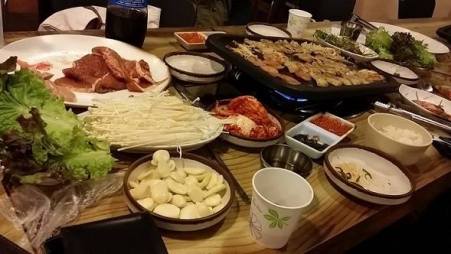
The ahjussi turned the portable gas griller on and the grilling began. As sir Randy held with a tong a slice of pork belly, like a teacher, he explained what samgyeopsal literally means: 삼- sam (three), 겹 – gyeop (layered), 살 – sal (flesh). His impromptu lecture did not end there. When the meat was cooked, he explained how to eat samgyeopsal the Korean way, that was after I excitedly picked up a piece of the cooked meat and had my first bite. He took a piece of meat, dipped it into a sauce then placed it on a leaf. Not done yet, he also added garlic and a bit of rice too. Then he rolled it up and stuffed it into his mouth.
“That’s the way the Koreans do it,” he said.
He made another roll and asked me to open my mouth. I hesitated at first because it was a little awkward. He explained that when dining Korean males usually do that and nobody would suspect them of “bromance.” So, I allowed him to stuff it in and returned the favor shortly after.
We learned quickly how to enjoy samgyeopsal. It was either sir Rhandy’s a good teacher or it was just our hunger. Soon enough, we had to order another round of pork belly.
There were two varieties of dipping sauces given to us by the ahjussi. Sir Randy told us that one is 쌈장 (ssamjang) and the other one 소금과 후추 기름 장 (sogeumgwa huchu gileum jang).
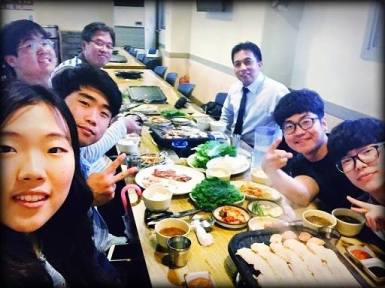
The kimchi served tasted differently from the one I first tried. No traces of sweetness. It was plain spicy.
While we were enjoying the “feast,” sir Randy who has been here in South Korea for a long time, recommended other kinds of Korean foods that he said he was sure I would come to like.
The other customers in the restaurant were enjoying their samgyeobsal with 맥주 (maegju) and 소주 (soju). We wanted to also but we had class the following day.
We were one in saying that it was a sumptuous dinner.
For me, it was not a simple dinner. It was a wonderful cultural experience.
— o —
Source: “Pork-bellied”
“Love at First Bite”
What’s the first food I ate here in South Korea? It’s biscuits (Skyflakes). No! I’m not kidding. I wasn’t able to eat any Korean food immediately when I and sir Ken (a fellow professor from the Philippines) arrived at the Busan International Airport. I was not thinking of food at that time. I was looking for at least a cup of coffee then, but neither because of hunger nor thirst. I wanted to feel the heat of the cup of coffee on my hands which started to go numb. It was freezing cold that morning on the 2nd of March, 2013 and hunger was the least of my worries. The only thing I wanted was to reach our destination at Gyeoungju-si and wrapped myself up with the thickest of blanket I could find there.
My jacket was not thick enough to minimize the effects of the early spring weather trying to give me an icy cold welcome. It was my mistake to believe what some friends back home told me that it’s not that cold here during Spring. For a body used to either hot or VERY HOT weather, experiencing a – 2 for the first time was literally a chilling experience.
As soon as I reached the apartment reserved for me by 경주 대학교, the first university where I worked, I immediately unpacked and got myself another jacket. It was only when I was warm enough that I started to feel hungry and realized that I was actually a time zone away from my family. Back home, my wife makes sure that whenever I’m hungry there’s food I could grab from either the fridge or the table. When I flew here, she stuffed my travelling bags with lots of food. So, officially, the first food I ate when I got here were biscuits.
I waited for another day to get introduced to Korean dishes that I had the chance to see only on TV through the Korean dramas that Filipinos like me are so fond of watching. I found it amusing that aside from wishing me well for the Korean adventure I was about to embark on, my family and friends keep telling me that finally I would have a chance to try the legendary kimchi.
Then finally the day came that something Korean would travel my digestive tract. I got that chance during the orientation for the university students held at the Concorde Hotel (Bomun Lake Resort, Bodeok-dong, Gyeongju-si, Gyeongsangbukdo). Of course, I was excited to meet my fellow professors from other countries and at least have a glimpse at how Korean university students look like and how they behave and talk. But I was, I think, more excited to have my first dining experience in South Korea. What made it more exciting was the fact that after that night, the taste of Kimchi would no longer be a mystery for me.
Right after the orientation, I joined the foreign professors and university officials and we all headed to the restaurant of the hotel. As we approached the dining hall, the ambrosial smell characteristic of hotel lobbies was replaced by a savory waft that was unlike any combination of aroma my olfactory receptors were used to. It made me hungrier and more excited.

There were four of us who shared one of the tables reserved. Already there (on the table) before we sat down were lots of 반찬 (banchan), or side dishes, mostly vegetables, including Korea’s “most-talked-about” – 김치 (kimchi). Yes…the first Korean food I tried was kimchi.
Despite my struggle with the chopsticks, I managed to lift a small chunk of this famous fermented cabbage to my mouth. The smell, as I expected, was biting and pungent. The tanginess was nothing new to me because in the Philippines there are items in our cuisine which I could say are perhaps more biting and more pungent than kimchi. What about the taste? It’s garlicky, salty and of course spicy. The first one I tried then had a combination of sweetness and spiciness. I was told that there are more than 100 known varieties of kimchi.
After my first bite, I immediately wanted more of it. Yes… I fell in love with kimchi. I don’t know why, let me just say that it was “love at first bite.” It is so hard to articulate as to why each time I eat I want a serving of this side dish.
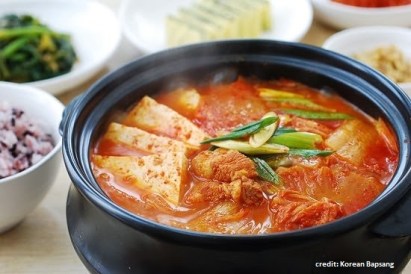
The main meal served was a kimchi-based dish called 김치 찌개 (kimchi-jjigae). Kimchi-jjigae is kind of stew where kimchi (preferably older or more fermented) is mixed with pork, seafood and diced tofu. I could handle spicy foods like this one. There are two problems though when I eat them. First, I sweat too much. Second and last, I probably would have up to 2 orders of extra rice. I was a little overweight when I came to South Korea. One of the things I set as goal when I came here was to get rid of the “belt bag.” With foods like kimchi-jjigae, I realized that night that losing weight is an impossible dream.
I completely abandoned my weight concerns when Randy, one of my fellow professors from the Philippines, told me that the following day he would introduce me to 삼겹살 (samgyeobsal).
 M.A.D. LIGAYA



 M.A.D. L I G A Y A